










When the Tame Dogs Turn Wild
A Breton note on progress, contempt, and teeth
Ar chas doñv yelo da ouez.
The tame dogs will turn wild.
Some sentences carry an entire people within them. This Breton sentence does. One might quickly file the song away as nationalist, if one is content with the usual drawers. But that would be too little. It is not merely a homeland song, not a sentimental landscape, not a folkloric echo from some prettily embroidered past. It is a warning.
Breton is a Celtic language. Those who do not know it first hear strangeness. Yet that very strangeness is instructive. Doñv means tame. Ouez means wild. Between them stands yelo da: will go to, will pass over into, will become. This is not a mere description of a condition. It is movement. Transformation. A crossing-over.
The tame dogs will not simply be wild all at once. They will pass over into wildness.
The song does not begin with uprising, but with humiliation. With a yoke. With high masters. With contempt and arrogance. With a “we” that has learnt to live quietly and humbly. For centuries, the text says. Centuries of shame.
This is the condition of the tamed.
To be tamed is not the same as to be peaceful. To be tamed means: accustomed to foreign hands. To foreign commands. To a foreign language. To foreign standards. A tamed people has learnt to see itself through the eyes of others. It knows when it is supposed to be silent. It knows when it is supposed to apologise. It knows when it is supposed to smile when its language is called a dialect, its piety backwardness, its landscape province, and its memory folklore.
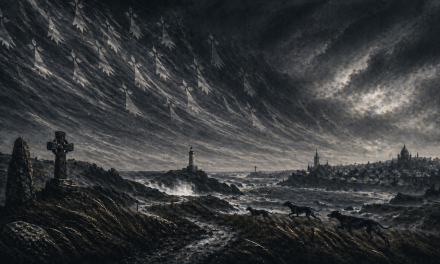
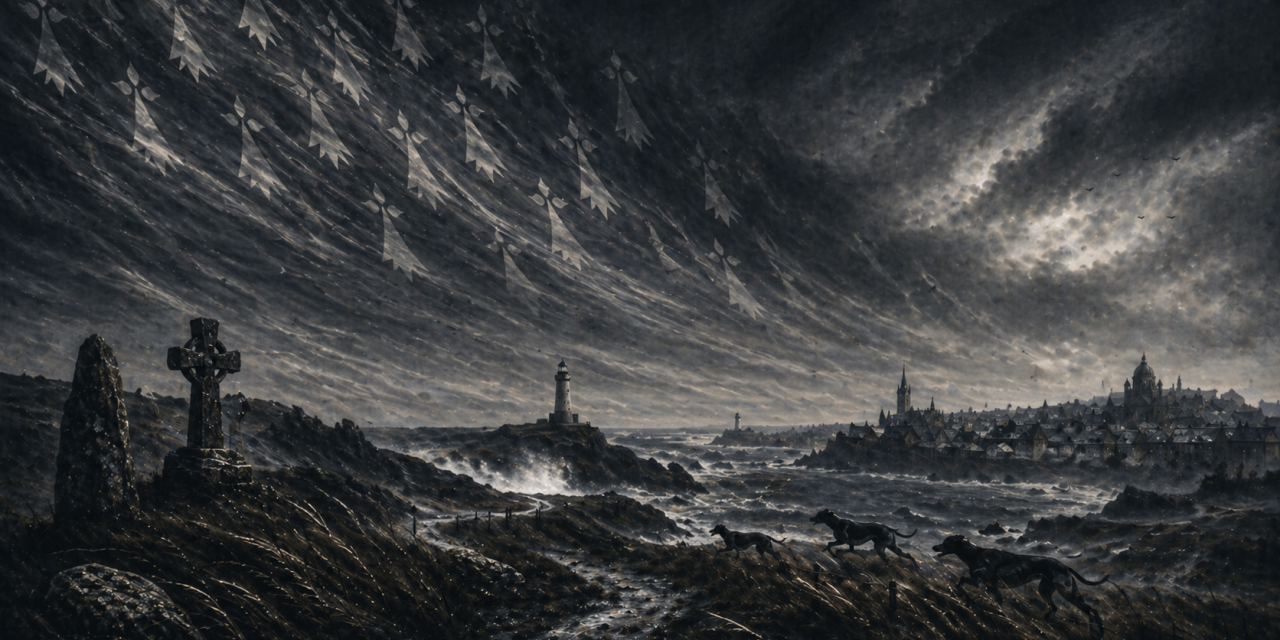
Then the wind moves through the woods and heathlands. The wind of the Ankoù.
The Ankoù is no pretty little figure from a tourist legend. He is death in Breton form. The text does not summon him by chance. Here no administrative district is speaking. Here an old landscape is speaking, with bones beneath the earth.
And this wind blows from the east.
From Brittany, what lies there is not the Promised Land, but Paris. In other countries the wind would have other points of the compass; here it comes from the direction of school, administration, language prohibition, and file. The wind of the Ankoù is no wind of departure or renewal. It moves through woods and heathlands like something that does not wish to quicken, but to kill off. The text does not say: all Frenchmen. It says something colder: some will rue it. The tamers first.
Then comes the long-awaited day. The people awakens. From the Monts d’Arrée to Nantes. This, too, is not a travel brochure. Nantes does not belong in this line by accident. To name Nantes is to name historic Brittany, not the administratively trimmed one. The sentence sets the old map against the new file.
And then:
Ar chas doñv yelo da ouez.
The tame dogs will turn wild.
One can also read this line against Friedrich Engels. Not against Engels as a bogeyman, not as a cheap villain for conservatives who have never read their classics. Rather, against a certain coldness of thought that appears in him in exemplary form.
In the revolution of 1848/49, Engels saw not only classes, programmes, and political camps. He saw peoples that fitted into history, and others that disturbed it. In this logic, the Bretons could appear to him as “ethnic trash”: remnants, appendages of reaction, peoples without a future, because they did not fit into his idea of progress.
That is the dangerous point.
For here the rhetoric of liberation tips over into contempt. Whoever does not fit into the great plan becomes historical refuse. Whoever is not revolutionary enough is not, say, different, wounded, bound, religious, peasant-like, stubborn, or cautious. He is finished. An obstacle. Material for the judgement of history.
This form of thought is one of the great fire-loads of the nineteenth century. The twentieth century supplied more than enough illustrative material for such sorting.
Progress loves its abstractions. People, class, humanity, future. The larger the word, the more easily the concrete human being disappears inside it. The Breton with his language. The peasant with his rosary. The singer with his old song. The landscape with its dead. The mother who still knows a word the state has no use for.
The Breton song does not answer this with theory. It answers with an animal image. It is not the revolutionary pose that bites back. The people does — in the language they tried to make it forget.
The tame dogs will turn wild.
That is not nice. But truth rarely has the manners its censors prescribe to it. For whoever has been tamed need not remain tamed for ever. And whoever was silent was not therefore in agreement. Sometimes silence was merely the form in which a people survived.
The masters of history like to confuse taming with essence. They take obedience for nature, loss of language for insight, adaptation for consent. They believe that a people has vanished when it no longer presents its case in the capitals.
But a tamed dog is not a piece of furniture.
It remembers.
And it has teeth.
Source note
The Engels passage refers to Friedrich Engels, “Der magyarische Kampf”, first published in the Neue Rheinische Zeitung. Organ der Demokratie, no. 194, 13 January 1849; reprinted in Karl Marx/Friedrich Engels: Werke, vol. 6, Berlin: Dietz, pp. 165–176. There Engels discusses what he calls “Völkerabfälle” and, in this context, also names the Bretons as “Stützen der Bourbonen von 1792 bis 1800” — supporters of the Bourbons from 1792 to 1800. The later intensification, according to which the next world war would make “ganze reaktionäre Völker vom Erdboden verschwinden” — whole reactionary peoples vanish from the face of the earth — and that this would be “auch ein Fortschritt”, also a form of progress, belongs to the same line of argument. The source compilation used here refers to Neue Rheinische Zeitung no. 194 of 13 January 1849, p. 2, to the standardised MEW version, and to the relevant formulations “Völkerruinen”, “Völkerabfälle”, and “gänzliche Vertilgung oder Entnationalisierung”.
For scholarly contextualisation, see Diane Paul, “‘In the Interests of Civilization’: Marxist Views of Race and Culture in the Nineteenth Century”, Journal of the History of Ideas 42/1, 1981, pp. 115–138, DOI: 10.2307/2709420. Paul discusses Marx’s and Engels’s views of race, culture, and civilisation in the nineteenth century and places Engels’s remarks on “reactionary peoples” within that context. The working note also refers to Paul, p. 137, and to Rosdolsky/Himka on the theory of “nonhistoric peoples”.
On the specific question of nationality in Engels, see Roman Rosdolsky, Engels and the “Nonhistoric” Peoples: The National Question in the Revolution of 1848, edited, translated, and introduced by John-Paul Himka, Glasgow: Critique Books, 1986.
 German